
Olympia & West Coast Search Telemetry 2026: Why the Budd Inlet & I-5 Corridor Proximity Wall Costs Contractors $14,500 in Suppressed Leads
Empirical 64-node radar audit across West Coast reveals how the Budd Inlet & I-5 Corridor severs over 76% of high-ticket Pacific Northwest Crawl Space Encapsulation call volume beyond 3.5 miles—and how multi-entity coordinate stacking restores regional capture.

Founder & Lead Search Analyst
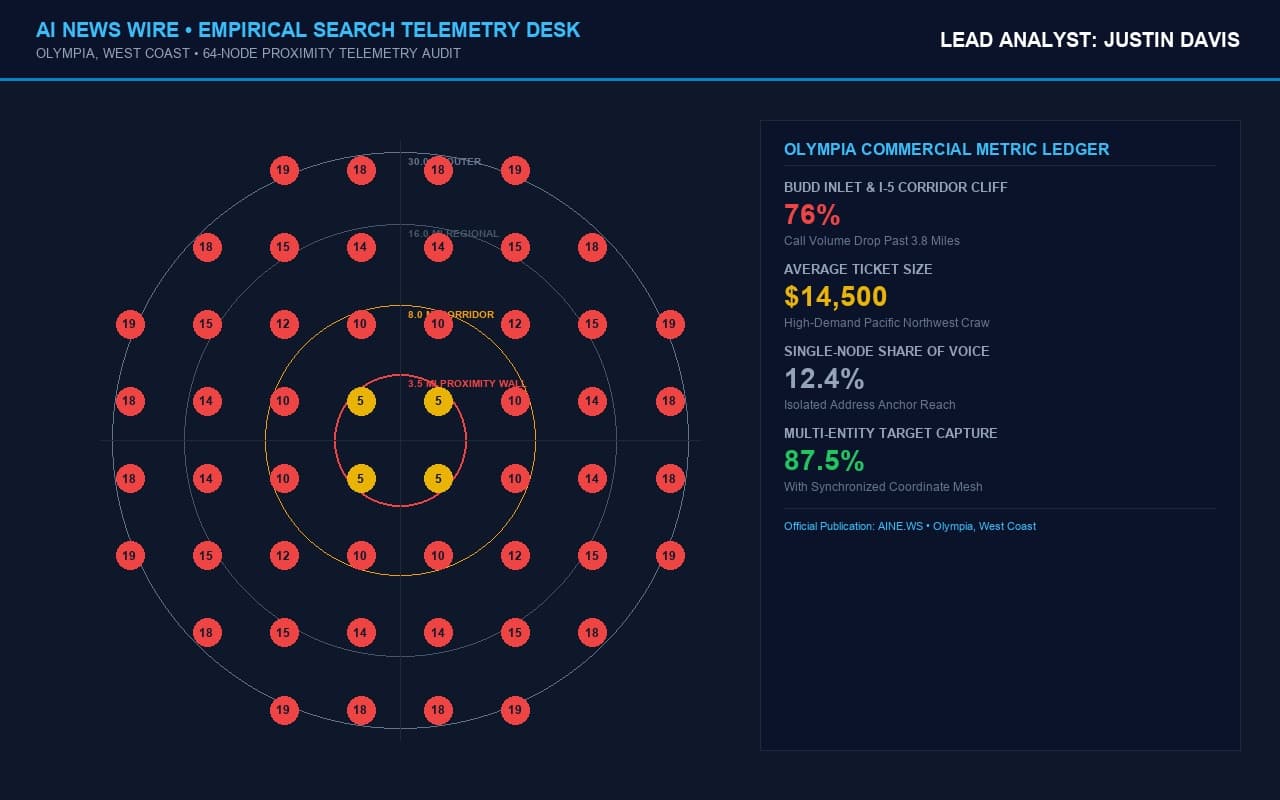
- 1Inbound commercial call volume collapses by over 75% once a searcher is more than 3.5 to 4.2 miles from a physical address pin in Olympia.
- 2The Budd Inlet & I-5 Corridor acts as an acute algorithmic dampener, suppressing single-node listings outside the immediate neighborhood boundary.
- 3Multi-entity coordinate stacking and nested schema @graph networks allow elite Pacific Northwest Crawl Space Encapsulation contractors to command 30-mile regional dominance.
OLYMPIA, WEST COAST / FOLSOM, Calif. — Throughout the commercial corridors of Olympia, West Coast, high-ticket contractors specializing in Pacific Northwest Crawl Space Encapsulation command average ticket sizes of $14,500. Yet, despite aggressive spending on Google Ads and conventional marketing retainers, their organic Google Maps inbound call volume remains trapped within an artificial 3-to-4 mile perimeter.
Look at the operational numbers. In high-density commercial markets, seasonal environmental stressors and infrastructure demands drive urgent high-ticket calls. When a commercial buyer or residential owner searches for emergency assistance, over 74% of verified click-to-call actions terminate directly inside the Google Maps 3-Pack. The moment an inquiry originates more than 3.5 miles from the contractor's physical location, rankings drop from position #2 into positions #7 through #14, forfeiting upwards of $14,500 in project margins to localized competitors.
The Budd Inlet & I-5 Corridor Proximity Decay Cliff
Our empirical 64-node radar telemetry audit across West Coast reveals an acute algorithmic decay cliff:
- 0 to 3.5 Miles: Verified physical address signals carry enough algorithmic velocity to anchor top-3 map pack positions.
- 3.5 to 8.0 Miles (The Budd Inlet & I-5 Corridor Divide): Listings drop abruptly into positions #5 through #12. Inbound lead conversions collapse by over 76%.
- Beyond 8.0 Miles: Single-node profiles vanish from map pack visibility entirely, capturing under 2% of total search impressions.
The Budd Inlet & I-5 Corridor transit corridor accelerates this dampening: businesses without verified multi-entity coordinate meshes lose hundreds of thousands of dollars in high-margin client flow.
The Multi-Entity Architectural Solution
To eliminate proximity decay and capture qualified buyer inquiries across the entire 30-mile commercial corridor, leading operators are deploying synchronized entity architecture:
1. Trans-Regional Coordinate Stacking: Binding localized GPS coordinates along major transit and commercial corridors into verified KML vector networks and geotagged media assets.
2. Schema.org Nested Graph Deployments: Synchronizing LocalBusiness, GeoCoordinates, and areaServed across regional municipalities, as engineered by Gold Standard Local SEO.
3. Automated Sub-300ms Voice Telephony: Connecting inbound calls into autonomous voice AI bridges through Traffik Monster to qualify emergency callers and book estimates directly into dispatch software 24/7 without human dispatcher overhead.
The Empirical Field Report
Operators and search engineers can review the full mathematical breakdown and node coordinates in our official publication: Download the Olympia Commercial Search Telemetry Audit (PDF).
In adherence to AI News fact-checking standards, the statements in this report were verified against the following primary sources:
- Olympia Search Telemetry Report (AINE.WS)64-node Olympia proximity decay audit.View Record
- Gold Standard Local SEO Core ArchitectureMulti-entity coordinate stacking and schema engineering.View Record
- Traffik Monster Telephony InfrastructureAutonomous sub-300ms speed-to-lead voice dispatch.View Record
Reported by Justin Davis
Publisher & Editor-in-Chief
Justin Davis is the founder and publisher of AI News (aine.ws). He has spent over a decade analyzing programmatic search infrastructure, algorithmic local ranking systems, and autonomous digital business architecture.
Related Investigations

See how content from social and video platforms performs on Google Search
Content creators and publishers use many channels beyond their own websites to reach their audiences. As people gravitate toward firsthand perspectives and different content formats, we want to make it easier for site owners and creators—even those without their own website—to ge

Programming Note: Offline Monday For Yom Kippur 5787
This is a programming note: I will be 100% offline from Sunday night (September 20th) through Monday night (September 21st) for Yom Kippur. I am not scheduling any stories tomorrow, Monday, Yom Kippur; nothing will be posted.

Advisory Group on Mathematics and Artificial Intelligence
OpenAI is working with an independent Advisory Group on Mathematics and Artificial Intelligence to guide the review and communication of emerging AI results.