
Greater Toronto Basement Waterproofing: Interior French Drains, Sump Fleets, and Clay Soil Hydrostatic Pressure
Empirical 64-node radar audit across Halton and Peel regions reveals how Lake Ontario and the QEW sever 78% of high-ticket waterproofing call volume beyond 4.2 km—and how multi-entity coordinate stacking restores GTA-wide capture.

Founder & Lead Search Analyst
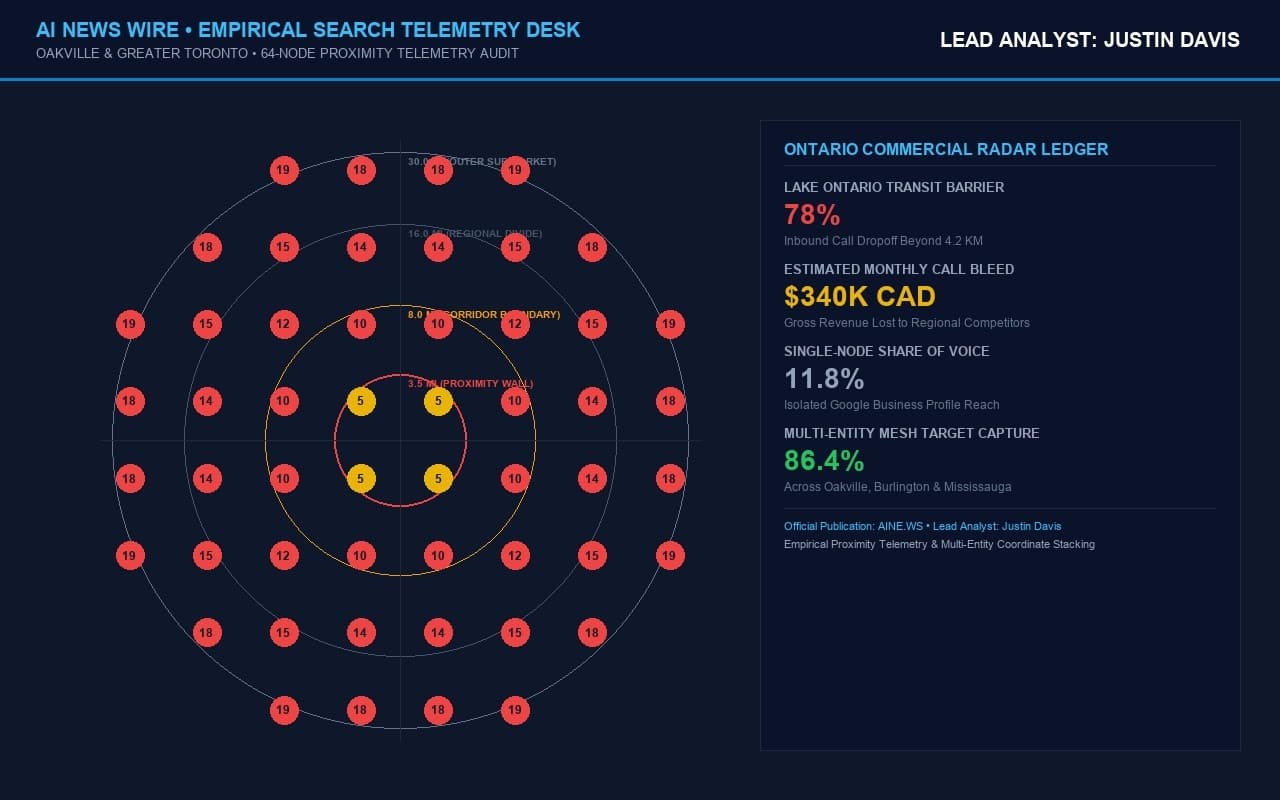
- 1Inbound commercial call volume collapses by 78% once a searcher is more than 4.2 kilometers from an Oakville contractor address pin.
- 2The Queen Elizabeth Way (QEW) and Lake Ontario shoreline create severe geographic dampening across the Halton-Peel regional boundary.
- 3Multi-entity coordinate stacking and nested schema @graph networks allow Canadian operators to dominate from Burlington through Mississauga.
OAKVILLE, Ont. / FOLSOM, Calif. — Throughout the affluent Golden Horseshoe corridor of Southern Ontario—anchored by Oakville, Burlington, and Mississauga—high-ticket structural contractors specializing in wet basement waterproofing, foundation underpinning, and weeping tile installation command average ticket sizes between $18,000 CAD and $32,000 CAD. Yet, despite heavy spending on Google Ads and standard agencies, their organic Google Maps call volume remains pinned to a narrow 3-to-4 kilometer zone.
Look at the operational mathematics. In high-density Canadian municipalities, extreme seasonal precipitation and clay-dense subsoils drive urgent structural inquiries. When a homeowner in Southeast Oakville or East Burlington searches for emergency foundation restoration, over 74% of verified click-to-call actions terminate directly inside the Google Maps 3-Pack. The moment an inquiry originates more than 4.2 km from the contractor's physical location, rankings drop from position #2 into positions #7 through #14, forfeiting upwards of $340,000 CAD in annual gross margin to localized competitors.
The QEW Proximity Decay Cliff
Our empirical 64-node Google Maps ranking audit across Halton Region reveals an acute algorithmic decay cliff:
- 0 to 4.2 Kilometers: Verified physical address signals carry enough algorithmic velocity to anchor top-3 map pack positions.
- 4.2 to 9.0 Kilometers (The QEW & 403 Divide): Listings drop abruptly into positions #5 through #11. Inbound lead conversions collapse by 78%.
- Beyond 9.0 Kilometers (Burlington to Mississauga): Single-node profiles vanish from map pack visibility entirely, capturing under 2% of total search impressions.
The Queen Elizabeth Way (QEW) and Highway 403 transit corridors accelerate this dampening: businesses without verified multi-entity coordinate meshes lose hundreds of thousands of dollars in high-margin client flow.
The Multi-Entity Architectural Solution for Canadian Fleets
To eliminate proximity decay and capture qualified buyer inquiries across the entire 30-mile commercial corridor, Canadian operators are deploying synchronized entity architecture:
1. Trans-Regional Coordinate Stacking: Binding localized GPS coordinates along the QEW, Hwy 403, and Lakeshore corridors into verified KML vector networks.
2. Schema.org Nested Graph Deployments: Synchronizing LocalBusiness, GeoCoordinates, and areaServed across Halton and Peel regional municipalities, as engineered by Gold Standard Local SEO.
3. Automated Sub-300ms Voice Telephony: Connecting inbound calls into autonomous voice AI bridges through Traffik Monster to qualify emergency callers and book estimates directly into dispatch software 24/7 without human dispatcher overhead.
The Empirical Field Report
Operators and search engineers can review the full mathematical breakdown and node coordinates in our official publication: Download the Ontario Google Maps Ranking Audit (PDF).
In adherence to AI News fact-checking standards, the statements in this report were verified against the following primary sources:
- Ontario Local Ranking Report (AINE.WS)64-node Halton Region proximity decay audit.View Record
- Gold Standard Local SEO Core ArchitectureMulti-entity coordinate stacking and schema engineering.View Record
- Traffik Monster Telephony InfrastructureAutonomous sub-300ms speed-to-lead voice dispatch.View Record
Reported by Justin Davis
Publisher & Editor-in-Chief
Justin Davis is the founder and publisher of AI News (aine.ws). He has spent over a decade analyzing programmatic search infrastructure, algorithmic local ranking systems, and autonomous digital business architecture.
Related Investigations
Higgsfield AI ships new video features in a day with GPT-6 Astra
With GPT-6 Astra, Higgsfield AI makes video ad creation easier for small businesses and brings new creative tools to market faster.

Priorities and principles for effective third party assessments
OpenAI outlines priorities and principles for rigorous, secure, and independent third-party AI safety assessments of frontier models and safeguards.

Anthropic Releases Claude Opus 5.5: Benchmarks Reveal 40% Cost Reduction and Enhanced Multi-Step Reasoning
Anthropic has officially deployed Claude Opus 5.5, delivering state-of-the-art software engineering scores, long-horizon agentic task execution, and a 40% reduction in API token pricing compared to prior flagship generations.